

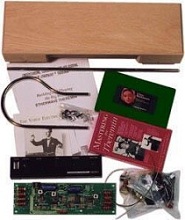
Thierry's been at it again, and his latest mod sounds great! The mod, demonstrated by Thierry himself in this video, is a small circuit soldered onto the main Etherwave circuit board. In addition to adding nearly 1.5 octaves of range on the low-end, one of the biggest improvements, in his own words, is that "the bass range of this instrument does not longer sound like a dying motorbike". I can't wait to order one myself!
Learn more about the mod at his website: http://theremin.tfrenkel.com




Feeds:
16 Comments
I love the mod for the EWPro, and want to try this one out too.
Naturally there are limits to how many instruments private individual builders can produce. Thierry's hitting an important mark here by improving Moog instruments that are already available to players en masse.
Still, I'm such a big fan of his work now, I would love to play a theremin totally of his own design.
Can't wait to see his next innovation!
Tu es si chouette. :)
With the module, you'll be able to play that not only less "farty" but also one octave lower if you want.
Another question... Why do many thereminists, among them you and "thereminstrel" only show their more or less wobbly paunch. Can't understand that... Do you fear to show your face to the public?
No, seriously... yes, in my case it started because I was embarrassed to show my face to the public (especially since my facial expression when playing is generally not nice, I think that happens to most beginning thereminists). Now I'm somewhat less embarrassed but I have gotten used to filming myself that way and it's hard to break the habit.
I'm really looking forward to get my hands on that mod and try to play that piece in a musical way :)
I would definately like to add this mod to my Etherwave Standard as soon as it is available.
Dominik
I make my own PCB's - Single or double sided, but not PTH, and no solder-mask or component overlay.. These are suitable for prototyping double-sided boards, and could be used for production on single-sided boards.
Single sided boards are REALLY SIMPLE.. Use a lazer printer to print onto Press-n-peel (http://cgi.ebay.co.u...) transfer paper [i](There are other, lower cost, transfer papers / films - But I have found these do not compare with Press-n-peel - they are all a lot more hassle for a lot lower quality result)[/i] , then use a laminator or iron to transfer the image to the PCB - Then etch the board - I found the The SENO etching kit (http://www.rapidonli...) a neat way to start.
With the above, one can make more than 10 Eurocard sized PCB's.. One can buy Ferric Chloride to top-up the etching bag - My bag lasted for more than 100 big boards! The biggest expense for small boards is a means of cutting the boards, and you need to have a PCB drill.. One can buy 0.8mm FR4 PCB which is a lot easier to cut and drill... A metal shear is cheaper than a bespoke PCB guillotine (£100 against £300) and is just as good .. But you can cut 0.8mm board with strong scissors.
Double sided boards are a lot more hassle - I do the 'solder' side on 0.8mm boards, and the component side on 0.2mm board, I then epoxy these boards together to form a 1mm (ish) double sided board. I have not found a reliable way to do the toner-transfer method directly onto a DS board.. Alignment always goes out.. Bonding two boards together allows one to use a light box and get the alignment perfect.
If you need any advice on any of the above, or getting boards made, just ask.. I have used most of the lower cost European PCB vendors, and know who to avoid! I also have some 0.8mm SS board I could spare (not easy to get in Europe - had to import a batch from the USA).
Fred.