

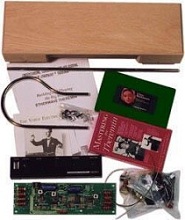
Following up on a string of amazing product releases in recent months, the the incredible engineers at Moog Music have once again proven why Moog is the world wide leader in theremin technology. Meet the new Moog Polyphonic Theremin!
Unlike traditional monophonic theremins, the Moog Polyphonic Theremin features 5 pitch antennas, enabling the player to control up to 5 different timbres at once. The MPR employs proprietary circuitry called IsoDirectional Inductive Oscillator Technology to allow individual control of each antenna with different fingers without interference from the other antennas.
Visit Moog's web site for the full details. Moog has even whipped up a instructional video with NY Theremin Society director Dorit Chrysler. If you never thought you'd hear Stairway to Heaven played in chords on a theremin, you've got to see how easy Dorit makes it look. The PolyTheremin ships with Dorit’s video and we'll all be happy to to hear that “Playing the PolyTheremin is Even Easier Than Playing a Monophonic Theremin.”





Feeds:
19 Comments
Thoughts?
There is no progress in my musical world for now. It has not yet been possible to organize a musical studio for one-voice and choir Theremin, Theremintone and my other new instruments, although there have been a number of promises from the managerial personnel. My daughter, the pianist Natasha (33 years old) practices on the multi-voice Theremin and follows as an example your playing on the gramophone record, but she is still far away from your accomplishment. On some of my concert-lectures, I show my playing on the multi-voice instrument and it creates a very good impression on the listeners. [...]
Yours,
Lev S
I think it's just impossible to control each rod with separate finger. I mean that each field should be pointed at exact finger. It's at least possible with lasers.
There are quite easy ways to overcome the problems of oscillator interactions - but there is no easy way to overcome the human limitations - as in, we only have two arms / hands!
Duophony is possible and workable - I have built a crude proof-of-concept prototype which has its pitch antenna split in the middle, and this [i](after processing a multiplexed oscillator connected to 'these' antennas)[/i] outputs two voltages - one voltage [CVS] is proportional to the combined capacitance seen by both antennas, the other [CVD] is a voltage proportional to the difference in capacitance seen by each antenna.
One voice [i](VCO and VCF)[/i] is driven from CVS, another voice is driven from CVS+CVD.
The two pitches can be controlled by raising or lowering the pitch hand, causing the difference between the capacitance seen by the upper and lower sections of the pitch antenna to change - the first ("master") voice is controlled in the normal way - distance from the antenna determining pitch.. the 2nd voice also tracks the distance, but pitch is offset by the vertical position of the hand.
The above is quite simple to implement, and within the realms of a DIY project. There are, however, some other issues which add a little complexity.
One wants (I believe) to have control of the output levels for each voice .. Adding an extra axis to the volume antenna gives this control - This axis (say left/right) controlling the mix level of the two voices.
The other problem is getting the oscillators pitch relationship to stay constant for a given vertical position.. It is similar to the linearity issue with theremins - as the hand moves closer to the pitch antenna, the vertical position required to maintain a constant pitch difference needs to change (quite dramatically on my prototype) and I have put this project on the shelf for now because I know that solving this will be quite a lot of work.. it is solvable (all the required data to compute and correct the pitch offset is available) but I have other theremins to get ready for HO 2011 - so I am leaving this one till last.. I hope I have time to complete it for HO 2011, but I doubt it...
Fred.
ps.. A clue for any experimenter wanting to start playing with this idea..
Designing the oscillators is the biggest problem - and I am not ready to share this yet! .. but one can all drive the antennas from a single fixed frequency oscillator (500kHz ish) each antenna coupled to the oscillator via a resistor (22k for example)..
Now, connect a buffer amplifier to each antenna (these need to be a voltage-follower op-amps with good frequency response).
As the capacitance seen by the antenna changes, the amplitude output from the op-amps will change (the antenna resistor and hand capacitance forms a variable voltage divider - remember, at 500kHz, 12pF looks like a 26.526k resistor, and 13pF looks like a 24.48pF resistor, so the signal level will change)
One then needs to rectify the signals, offset them, and amplify them to get a usable DC variation... And take these voltages for further processing to get the VCO and VCA control signals.
The above has no EQ correction, and is only usable over a short sensing distance, and is sublect to induced noise, and is not much use for a practical instrument.. But it is extremely easy and can be thrown together in a few hours (one can get a much better result if you use inductors and form tuned circuits on the antennas - but that is another story..).
The left hand of the player controlled voice two by moving from left to right, the right hand controlled voice one by moving back and forth (in the usual way). Volume was also controlled by the left hand (in the traditional way) because left/right movement was not hampered by the up & down movement required for expression.
Anyone who is seriously interested in the possibilities of the kind of ten finger polyphonic interface we saw in the Moog April Fools video should investigate the Haken continuum. It can play anywhere from 1 to 16 voices, each voice controllable in three dimensions: left to right, forward & backward, up & down.
<laughs out loud>
didnt get it until my second viewing.
I actually just had friend who ask if I had "seen the new theremin that just came out?"
How long do you think they will keep up the page?
**sigh**
In other words, it don't float my boat....
Philip
LOL! ;-)
As I understand it, one simply needs to download the hotrodding manual eight times... and that Moog will be publishing the IDIOT's technical reference manual and guide to polyphonic theremins, probably early April 2012.
Fred.