














|
If you've seen pictures of Leon Theremin or Clara Rockmore playing their
classic theremins, you've undoubtedly noticed the majestic diamond-shaped
speakers towering behind them. While the actual shape of the speaker enclosure
is more for aesthetic purposes, having the speaker positioned directly behind
your head will help you quickly make subtle adjustments to pitch as you play.
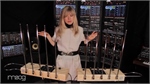
This article will show you how to build a theremin speaker like the one
shown in figure 1. Once you've built one, send us a picture and we'll post it
in the photo gallery.
Step 1 - The Soundboard
The soundboard serves to amplify the sound made by the theremin speaker. For
our speaker, we used a piece of 1/4 inch smoked plexiglass from Tap Plastics. You
can use any material you wish, as long as it's thin and strong. Plexiglass
is fairly easy to work with, and Tap Plastics will even cut the rounded
edges for you in-house. If you're going for a more classic look, a sheet of
hardwood would also do nicely.
Start by cutting the Plexiglass into a square shape with rounded corners.
Our speaker is approximatetly 2 feet by 2 feet (from tip to tip).
Next, mark the center of the sheet and cut 5 thin vertical slats as shown
in figure 2. These will allow some sound to escape the speaker directly
and some sound to cause the soundboard to vibrate.
To cut the slats, I first used a 1/2 inch drillbit to drill holes at each
end of the slat. Then, I cut out the slat between the holes with a coping
saw. If you're using wood, you might have better luck with a jigsaw
or router. File the slats and sand them to make them smooth and even.
Now, set the soundboard aside. We'll come back to it in a moment.
Step 2 - The Speaker
You can use any type of electric instrument spealer you wish for the
speaker. I used the a 5 inch speaker from a small guitar practice amp by
Kustom that I found in a local pawnshop for $25. You can find amplifiers of
all shapes and sizes online at zZounds.com.
I cut the wires from the speaker to about 3 inches and soldered on a 1/4" audio jack from
Radio Shack. Then, you can connect your speaker and your amplifier using any standard 1/4" amplifier
cable.
Place the speaker face down on the back of the soundboard and use a nail or other sharp
object to mark the mounting holes. Then, drill the holes and attach the speaker to the
soundboard (see figure 3).
Step 3 - The Stand
For the speaker stand, we used a Rogue brand lighting stand from Musician's Friend (see figure 4). It's
quite sturdy offers adjustable height and legs for stability.
The stand comes with a crosspiece you can use to hand lights from. We used a hacksaw to cut the crosspiece
down to about 4 inches wide (see figure 5). The round piece at the bottom drops into the top of the lighting
stand. Drill two holes in the crosspiece about 1/2 inch in from the sides.
Next, cut your piece of aluminum angle to the same width as the crosspiece (see figure 6). On one side, drill
two holes that line up with the holes you made in the crosspiece. Bolt together the crosspiece and the angle
bracket.
On the other side of the angle bracket, drill 4 holes in the corners. This side will be used to attach the bracket
to the soundboard. Lay the bracket down on the soundboard and mark & drill holes to line up. Then, bolt the angle
bracket to the soundboard on the same side as the speaker (see figure 7).
Step 4 - Putting it all together
Finally, drop the mounting peg on the bracket into the top of the stand and tighten using the knob on the stand.
Voila! You're finished!
Got an idea or tip for this project? Share your comments with others on the
ThereminWorld message boards.
|

Figure 1 - Theremin Speaker

Figure 2 - Slats in the soundboard

Figure 3 - Mounting the speaker

Figure 4 - Adjustable lighting stand

Figure 5 - Cut the crosspiece to make a bracket for mounting the soundboard

Figure 6 - Aluminum angle for mounting bracket

Figure 7 - Closeup of the mounting bracket on the soundboard

Figure 8 - The finished product!
|