
Meet the Theremin
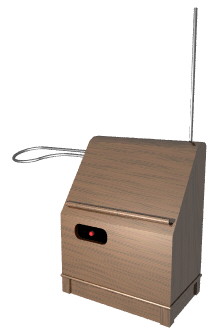 The theremin was invented in 1920 by a Russian physicist named Lev Termen (in the United States his name was Leon Theremin). Today, this marvelous instrument is once again in the musical spotlight.
Besides looking like no other instrument, the theremin is unique in that it is played without being touched.
Two antennas protrude from the theremin - one controlling pitch, and the other controlling volume. As a hand approaches the vertical antenna, the pitch gets higher. Approaching the horizontal antenna makes the volume softer. Because there is no physical contact with the instrument, playing the theremin in a precise melodic way requires practiced skill and keen attention to pitch.
In the early 1920's, Leon Theremin came to the United States to promote his invention. He was given a studio to work in, and he trained several musicians to help bring the theremin into the public eye. Then, in 1938, Leon Theremin was taken back to the Soviet Union by force, leaving behind his studio, friends, business, and his wife. After a stay in a prison camp, Leon Theremin reportedly worked for the KGB designing among other things, the "bug" and methods for cleaning up noisy audio recordings.
The Theremin in Music & Film
Originally, the theremin was intended to play classical music and even replace entire orchestras with its "music from the aether." While that never quite happened, it has been used in many recordings over the years. Several big band conductors featured the theremin in numerous specialty ablums. During the 60's and 70's, bands such as Lothar and the Hand People, the Bonzo Doo Dah Dog Band, and Led Zeppelin brought the theremin into the public eye for a short time. (However a theremin did not play in the song "Good Vibrations", but the instrument used was based on it.) Then, the theremin slipped back into obscurity until the recent revival of the 1990s. Today, lots of bands use theremins, though many unfortunately limit themselves to using the theremin as a novelty.
The spooky sound of the theremin was used in several movie soundtracks during the 1950's and 1960's. It provided background mood music for such sci-fi classics as The Day the Earth Stood Still, where it played a serious musical role, and It Came From Outer Space, as well in classic, well composed, thriller soundtracks such as Spellbound and The Lost Weekend.
In 1993, Steven M. Martin produced a documentary entitled Theremin - An Electronic Odyssey
A Star Is Born
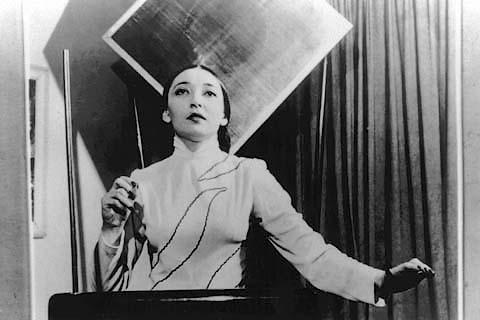 One of Prof. Theremin's original students was a Russian-born musical prodigy named Clara Rockmore. By age 5, Clara was already an accomplished violinist. But then a problem with her hands forced her to give up the violin in favor of the theremin. Clara went on to become the world's best thereminist, developing a unique method of "aereal fingering" to play the theremin with unparalleled precision. You can hear Clara perform on the album, The Art of the Theremin, accompanied on piano by her sister, Nadia Reisenberg.
A Family Tree of Theremins
In the late 1920's, RCA produced approximately 500 theremins, manufactured by General Electric and Westinghouse. Today, it is estimated that only half of these still exist. An effort is underway to track down the remaining models. You can read more about these theremins in our RCA Theremin Registry.
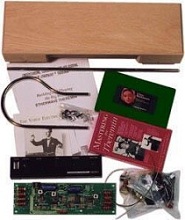
Electronic music pioneer Robert Moog built theremins long before he built synthesizers. In the 1960's, he produced such models as the wedge-shaped Vanguard theremin and the shoebox shaped Moog Melodia theremin. Today, Moog Music Inc. produces the popular Etherwave and Etherwave Plus theremins and kits as well as the new MIDI-enabled Theremini theremin. Other popular models today include PAiA's Theremax and Burns' line of B3 theremins. Theremin kits continue to surge in popularity today like guitar kits due to the growing DIY market in music.
Just the beginning...
We hope you enjoy our community as you learn more about theremins. If you have any questions or new material to submit to the website, please don't hesitate to contact us.